

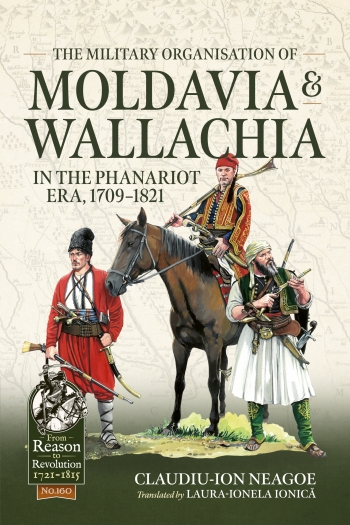
THE MILITARY ORGANIZATION OF MOLDAVIA AND WALLACHIA IN THE PHANARIOT ERA, 1709-1821
Autore: Claudiu-Ion Neagoe
Codice: 283560
From Reason to Revolution 1721-1815 #160
In the summer of 1806, Charles-Frédéric Reinhard, French commissioner in the Romanian Principalities, famously declared that Moldavia and Wallachia possessed no real armies—only a handful of men listed on police registers, exempt from taxes and tasked with guarding borders, carrying dispatches and serving local officials. For generations, historians echoed this judgement, arguing that the succession of Phanariot rulers in the eighteenth century led to the effective abolition of the military forces of the two principalities. This book challenges that long-standing assumption.
Drawing on a careful re-examination of archival material, administrative records and contemporary accounts, Claudiu-Ion Neagoe demonstrates that the armies of Moldavia and Wallachia were not abolished during the Phanariot era. Rather, they were reshaped. Reduced in size during peacetime—often for fiscal reasons—they continued to function as instruments of border defence, internal order and tax enforcement. In moments of crisis, their strength could be rapidly expanded, as the Ottoman authorities required the recruitment of local volunteers and Balkan mercenaries to serve as auxiliary forces alongside imperial troops.
Set against the complex political backdrop of Ottoman suzerainty, Russian expansion and Habsburg pressure, this study explores how military institutions adapted to a changing geopolitical environment. It traces the evolution of command structures, recruitment systems, fiscal mechanisms and the social composition of the armed forces across more than a century of Phanariot governance. Far from being marginal or ceremonial, these forces remained embedded in the political and administrative fabric of the principalities.
Neagoe situates the military organisation of Moldavia and Wallachia within broader European and Ottoman military developments of the eighteenth and early nineteenth centuries. He examines the balance between autonomy and dependence, showing how local rulers navigated the demands of imperial overlords while preserving functional armed structures suited to regional realities. In doing so, the book contributes not only to Romanian military history, but to the wider study of small-state military adaptation under imperial dominance.
By dismantling the myth of military disappearance and replacing it with a nuanced account of institutional continuity and transformation, The Military Organisation of Moldavia & Wallachia in the Phanariot Era restores a vital chapter of Eastern European military history. It reveals how, even under fiscal constraint and political subordination, the structures of organised force endured—and how they laid important groundwork for the later national armies of the nineteenth century.
A rigorous and revisionist study, this volume offers fresh insight into the military realities of the Romanian Principalities during a period too often misunderstood as one of simple decline.


INGLESE
43 illustrazioni in bianco e nero e 8 tavole a colori
230
16 x 25